
Legal News
United Fidelity Bank Fails: What Depositors Need to Know
By Attorneys.ORG Team
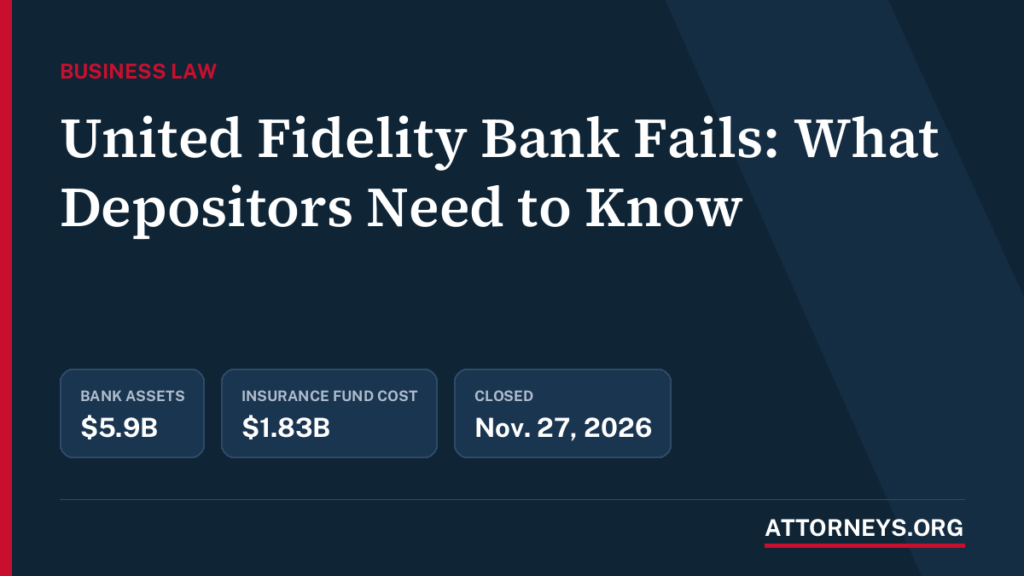
Federal regulators closed United Fidelity Bank, fsb, of Evansville, Indiana, on the evening of Friday, November 27, 2026, in the largest U.S. bank failure since April 2024. The Office of the Comptroller of the Currency shut the lender after concluding it was in an unsafe or unsound condition and was likely unable to pay its obligations or meet depositors’ demands in the ordinary course of business.
The Federal Deposit Insurance Corporation arranged for First-Citizens Bank & Trust Company of Raleigh, North Carolina, to take over the failed bank’s deposits and buy its assets. United Fidelity’s 22 branches in Indiana, Illinois, Florida, Colorado and the U.S. Virgin Islands began reopening as First Citizens locations on Saturday, November 28. Regulators say customers who moved to First Citizens keep all of their money, but certain brokered deposits were left out of the deal.
How Big Is the United Fidelity Failure?
United Fidelity reported about $5.9 billion in assets and $5.4 billion in deposits at the end of September. The FDIC estimates the failure will cost its Deposit Insurance Fund $1.83 billion, roughly 31 percent of the bank’s assets, which is an unusually steep loss for a bank of this size.
It is the biggest failure since Philadelphia’s Republic First Bank went down in April 2024 with roughly $6 billion in assets.
First Citizens, which also bought much of Silicon Valley Bank after its 2023 collapse, agreed to take on about $3.1 billion of United Fidelity’s loans, but only after securing a $2.6 billion discount on the assets it purchased. A discount that large signals the buyer expects some of those loans to perform poorly. Neither United Fidelity nor its regulator has publicly explained what caused the bank’s financial trouble.
What Happens to Deposits and Loans
For most customers, the change is designed to happen in the background. Regulators said United Fidelity depositors automatically become First Citizens depositors, keep all of their funds and keep their deposit insurance coverage, with no need to open new accounts or change their banking relationship. Customers could continue writing checks, withdrawing cash at ATMs and using debit cards throughout the holiday weekend.
Regulators also told customers to keep using their existing United Fidelity branches for now, said checks drawn on the bank will continue to be processed, and instructed borrowers to keep making loan payments as usual. A loan does not go away when a bank fails. It simply has a new owner.
The Brokered Deposit Gap
The group that needs to pay the closest attention is people who placed money at United Fidelity through a broker or other middleman. First Citizens said it is assuming about $4.5 billion in deposits, roughly $900 million less than the $5.4 billion the bank held at the end of September, and the FDIC said certain brokered deposits were excluded from the transfer. The agency has not said how many accounts fall into that category.
Brokered deposits are funds a third party places with a bank on a customer’s behalf, often in the form of certificates of deposit sold through brokerage firms. Because those accounts did not move to First Citizens, anyone holding one should confirm directly with the firm that sold it how the money is being handled and when it will be available.
What This Means for You
- If you banked directly with United Fidelity, you are now a First Citizens customer. Regulators say you keep your full balance and your insurance coverage, and you do not need to do anything to protect your money.
- Keep paying any mortgage, auto or business loan you had with United Fidelity on schedule. A change in ownership does not excuse a missed payment, and late payments can still bring fees and credit damage.
- If you own a United Fidelity CD that you bought through a brokerage account, contact your broker to confirm the status of those funds.
- Standard FDIC insurance covers up to $250,000 per depositor, per insured bank, for each account ownership category. It applies to checking, savings, money market deposit accounts and CDs, but not to stocks, bonds, mutual funds or cryptocurrency.
- The FDIC posts updates for affected customers on its United Fidelity Bank information page.
Most everyday depositors will not need legal help. It may be worth speaking with a banking or business attorney if you held brokered deposits that did not transfer and cannot get clear answers, if your business had large balances or a pending loan with United Fidelity, or if the bank owed you money as a vendor, landlord or other creditor when it closed.
Frequently Asked Questions
Did United Fidelity Bank customers lose their money?
Regulators say depositors whose accounts moved to First Citizens keep all of their funds and their deposit insurance coverage. Certain brokered deposits were excluded from the transfer, so anyone who bought United Fidelity CDs through a broker should check with that firm.
Who took over United Fidelity Bank?
First-Citizens Bank & Trust Company of Raleigh, North Carolina, assumed the deposits and bought the assets. The 22 former United Fidelity branches began reopening under the First Citizens name on November 28, 2026.
Do I still have to make my loan payments after United Fidelity closed?
Yes. Regulators told borrowers to keep making their loan payments as usual, and checks written on United Fidelity accounts will continue to be processed.
Sources: